
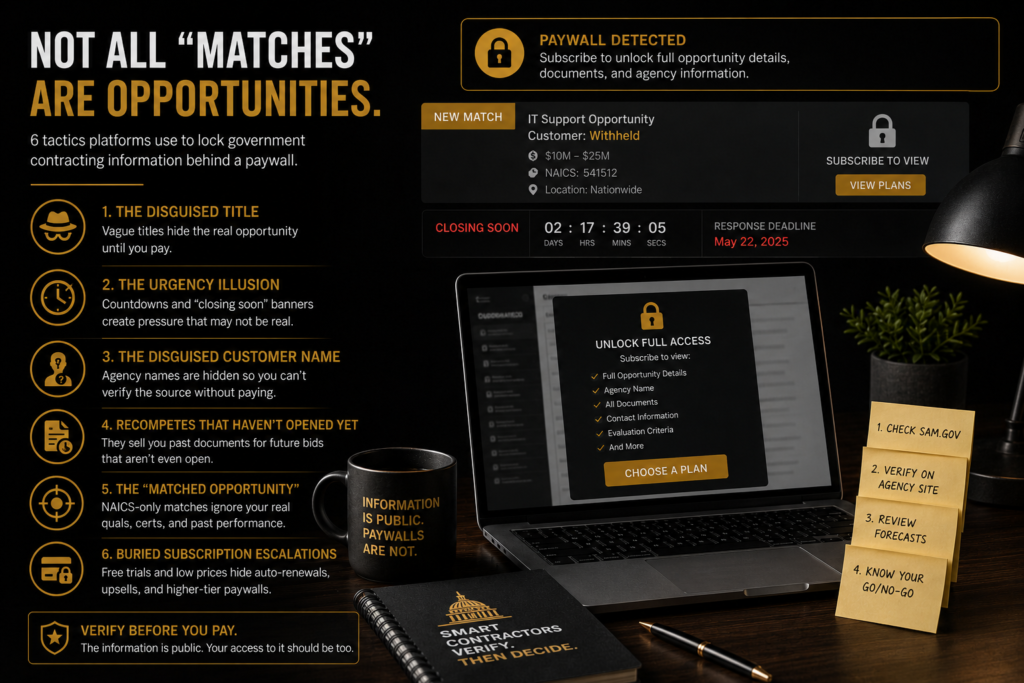
Some paid lead aggregator sites use tactics that cost you time, money, and pipeline confidence. Here’s what to watch for — and how to protect yourself.
If you’ve spent any time trying to find federal and state contracting opportunities, you’ve probably encountered paid platforms that promise to bring vetted, matched opportunities straight to your inbox. Or maybe you received an unsolicited email from someone (who isn’t the government), notifying you that an opportunity “might” be a fit for you. And for a small business owner who is already stretched thin, that sounds like a dream.
But here’s what many of those platforms won’t tell you upfront: a significant number of the “opportunities” they surface are either publicly available for free, not yet open for bidding, or dressed up in ways designed to make you think you need a subscription to access them at all.
This isn’t to say all aggregators are bad actors. Some provide genuine value. But some use tactics that are worth knowing about — because once you can recognize them, you’ll stop paying for things that were never really out of reach.
What's Actually Happening
Most federal contracting opportunities are published on free, publicly accessible government platforms. Not all are accessible via API either; for example, have you ever seen a FedConnect solicitation in any paid system?
State and local opportunities often have their own portals — also free or low-cost to access directly. Paid aggregators scrape those sources and repackage the data. That repackaging can be valuable. But it can also be deceptive.
Here are the most common tactics I’ve seen used against small business contractors:
Tactic 1: The disguised title
Some platforms intentionally obscure the title or agency name of an opportunity in the preview, replacing it with a vague description like “Defense-Related Services Contract” or “IT Support Opportunity — Agency Withheld.” The message is clear: pay to find out more. But the underlying solicitation is almost always already publicly posted — for free — on the issuing agency’s portal or a government aggregator. The paywall is protecting access to information you already have a right to see.
Before you subscribe: Try copying the NAICS code, dollar value, and any visible keywords into a free government search tool. The original solicitation is usually already there.
Tactic 2: The urgency illusion
Countdown timers, “closing soon” banners, and bold deadline text are common features on some platforms. Sometimes that urgency is real. Sometimes the listed due date is months away — or the opportunity is still in a pre-solicitation stage with no response required at all. The goal is to create pressure that makes you subscribe now rather than pause and verify.
Before you act: Always confirm the actual response deadline on the issuing agency’s original posting. Urgency displayed on a third-party site is not the same as the official deadline.
Tactic 3: The disguised customer
Some platforms list opportunities under a branded group or consortium name rather than the actual issuing agency. You might see something like “Regional Purchasing Cooperative” or “State Procurement Group”. Basically, names that sound official but tell you nothing about who is actually buying, what state you’re looking at, or whether the opportunity is even relevant to your business. The real agency name is locked behind the subscription.
This tactic is particularly effective because it creates the illusion that the platform has exclusive access to opportunities you can’t find anywhere else. In reality, the underlying solicitation is almost always posted directly on the issuing agency’s own procurement portal, free and fully accessible, if you know where to look.
Before you subscribe: Search the consortium or group name to find out which agencies participate and which states they cover. Then go directly to those agencies’ procurement portals. Chances are the opportunity is sitting right there.
Tactic 4: Recompetes that haven't opened yet ... and charging you for the documents
This one is particularly frustrating. A platform will list an upcoming recompete or something on a forecast for a contract that’s expected to be re-bid when the current one expires — and offer to sell you access to the current contract’s performance work statement, technical documents, or prior solicitation files. Here’s the problem: those documents are almost always available for free from the agency, or from the original SAM.gov posting. Some agencies post them proactively. Others will send them if you email the Contracting Officer. You are being charged for a file-retrieval or FOIA request service dressed up as market intelligence.
Before you pay for documents: Check the original SAM.gov (or equivalent) posting, the agency’s acquisition forecast, and FOIA request options. You may already have legal access to everything they’re selling.
Tactic 5: The "matched opportunity" that isn't a match
Automated matching algorithms are only as good as the data behind them — and many platforms match on NAICS codes alone, without considering your company’s size, certifications, past performance threshold, or geographic scope. What gets served to you as a “strong match” may be a set-aside for a certification you don’t hold, a requirement for a clearance level you haven’t obtained, or a task order under an existing vehicle you’re not on. The match looks compelling on the surface. Getting deeper often reveals it’s not a real opportunity for your business at this stage.
Before you pursue: Always run a quick go/no-go check before chasing any opportunity — matched or not. NAICS alone is not qualification.
Tactic 6: Buried subscription escalations
Some platforms offer a “free trial” or a low entry price that locks you into an auto-renewing subscription before you’ve had a chance to evaluate whether the platform actually serves your market. Others gate the most useful features like full opportunity text, agency contact details, or download access behind higher pricing tiers; revealed only after you’ve already committed. The result is a layered upsell structure that can cost far more than advertised.
Before you enter payment information: Read the cancellation terms. If auto-renewal isn’t clearly disclosed upfront, that’s a signal.
What You Can Do Instead
The free government tools available to small businesses are more powerful than most people realize. SAM.gov offers robust search and filtering for federal opportunities. Many agencies post acquisition forecasts publicly. Subcontracting opportunities are often listed on prime contractor websites. State procurement portals exist in all 50 states.
For contractors who want a more sophisticated research experience without the paywall games, tools like HigherGov are worth exploring. It’s built to surface federal opportunity intelligence in a way that’s actually useful; with context, history, and agency data that helps you make smarter go/no-go decisions before you invest time in a pursuit.
None of this means you should never pay for a tool. The question is whether you’re paying for access to information — or insight you couldn’t easily develop yourself. There’s a real difference between the two, and it’s worth knowing which one you’re buying.
A rule worth keeping: If a platform’s primary value proposition is showing you something that the government itself publishes for free, pause before subscribing. Aggregation is a convenience, not a right to charge for public information. Know what’s behind the paywall before you hand over your card.
Why This Matters for Your Pipeline
Your pipeline is only as good as the quality of the opportunities in it. When you’re spending time and money chasing leads that are paywalled versions of free data, pre-solicitation recompetes with no current action required, or “matched” opportunities that don’t actually fit your company profile, that’s capacity you’re not spending on real capture activity.
Building a disciplined, go/ no-go-driven pipeline from verified sources isn’t as glamorous as getting a curated list in your inbox. But it tends to produce far better results and it keeps you from chasing your own tail every time a new platform runs a special offer.
As always, I’m rooting for you to make smart decisions with every dollar and every hour you invest in this process. The opportunities are real. The tactics being used to monetize your access to them don’t always deserve your money.
A note from Ashley As a HigherGov partner, subscribers who subscribe through Duwel Dev receive a 1:1 custom onboarding call to work through code validation and search parameters together. This isn’t just a nice-to-have, considering roughly 85% of small businesses are working with incorrect or outdated codes..This means the data in any platform will be skewed before you even start. Getting this right at the foundation changes everything downstream. Get Started with HigherGov and ask about our pipeline automation support.
